Wednesday, December 9, 2015

A MISCREANT CALLED KEMI OMOLOLU-OLUNLOYO

Kemi Omololu-Olunloyo
 
Kemi is a daughter of former governor of Old Oyo State, Pa Victor Omololu Olunloyo, she was deported from Canada in 2012 because she got to the country illegally.
Lunatic Mode Activated
 
“She and her son, Kayode Joshua (KJ), 11, have been packing their belongings for the trip home.
Omololu-Olunloyo said KJ ran away from home for several hours on Thursday and police had to called to help find him.
“He does not want to go back to Nigeria,” she said. “I know I will be killed when I return for what I have written against the government.”
Omololu-Olunloyo said some of her blogs and tweets have been against the government of Nigeria.
“I am a journalist and it will be only a matter of time before I am killed,” she said. “The government do not like people who ask a lot of questions.”
Omololu-Olunloyo arrived at Pearson airport from Nigeria, via the U.S., in 2007 with her children and filed unsuccessful refugee claims and subsequent appeals. She has to report on May 4 to a 6900 Airport Rd. office of the Canada Border Services Agency (CBSA) to set a date for removal.”
Culled from http://www.torontosun.com/2012/04/27/kemi-and-family-face-deportation
She was born and raised in Nigeria.  She moved to the United States.  She lived there for decades.  She never got American citizenship.  She got charged for several criminal offenses in Georgia, USA.  She jumped bail and went back to Nigeria.  A year later in 2007, she came to Canada and claimed refugee status.  After 5 years, she was deported to Nigeria.  But before she was deported, they arrested her and held her in jail for a week.

This woman is threatening to come back to Canada as a visitor.  This woman does not have a real job in Nigeria.  The reason I know this is because she is very active on social media.  Her family supports her financially.


Culled from : http://www.canadavisa.com/canada-immigration-discussion-board/deported-refugee-being-allowed-to-visit-or-claim-refugee-status-in-future-t204340.0.html
Back to Nigeria, she has been constituting nuisance to her family, to her tribe and to the Nigerian society particularly online. She claims to be a pharmacist, jounalist and blogger but she is the most insultive Nigerian online. She uses words like Yorrober, Dumbass, Dumfuck, Illiterates, Cockroacha (For Gov. Okorocha of Imo) etc to describe her people. She did not leave her own biological father out of her insults, She describes her own father as a RITUALIST and a KILLER, that the man who is aging gracefully also threatened to kill her on 3/11/15, she said her step-mother confessed that she took Dr. Olunloyo to Idanre and Ibefun for rituals purposes and that her father TORTURED her mother and siblings using rituals, power and lies. She was beaten to stupor by one of her sisters – Funke who could not stood her (Kemi) lunatic behaviour.

 
At 51, Kemi's brain is upside down
 
Her recent issue with one Tokunbo Aboderin is shown in the screenshot below:
 

Kemi has no job, no means of survival except for the the assistance by family members, her latest stock in trade is to capitalize on the gullibility of a section of Nigeria to gain little traffic to her not blossoming blog. She pose to destroy people by tagging them anti-Igbo, especially for those whose comments don’t support the division of the country. 
On Tuesday, 8th of December, in order to pull traffic to her not popular blog, she did a post on Wale Adetarami CEO of @Travelsnaija, claiming that the young enterpreneur mocked the death of one of the Biafra agitators, meanwhile, the youngman only said that children of Nnamdi Kanu are safe in the UK while some are killing themselves over the flame he ignited.
Kemi hates the Igbos, he calls them #Biafraud, but needs them now for traffic to her blog. See link. :  http://kaanayo.com/index/blogs/canada-to-deport-igbo-hater-and-nigerians-basher-kemi-omololu-olunloyo-in-a-few-days/ 
At 51, Kemi is still living an aimless life, can’t all Ibadan people converge and take her to a psychiatric hospital or tie her down if she can’t get a life?
From : @TravelsNaija crew Like us: https: http://www.facebook.com/Travelsnaija/

Thursday, April 30, 2015

MUST READ: Abraham Lincoln’s letter to his son’s teacher.....@Travelsnaija @WaleAdetarami

                                                                   Abraham Lincoln

He will have to learn, I know, that all men are not just, all men are not true. But teach him also that for every scoundrel there is a hero: that far every selfish politician, there is a dedicated leader.

Teach him that for every enemy there is a friend. It will take time, I know a long time, but teach, if you can, that a dollar earned is of more value than five of found.

Teach him, to learn to lose... And also to enjoy winning. Steer him away from envy, if you can, teach in the secret of quiet laughter.

Teach him, if you can the wonder of books... But also given quiet time wonder the eternal mystery of birds in the sky, bees in the sun, and flowers on the green hillside.

In a school, teach him, it is far more honorable to fail than to cheat.

Teach him to have faith in his own idea, even if anyone else tells him they are wrong.

Teach him to be gentle with gentle people and tough with tough.

Teach him to listen to all men... But teach him also to filter all he hears on a screen of truth, and take only the good one that comes through.

Teach him, if you can how to laugh when he is sad. Teach him there is no shame in tear.

Teach them to sell his brawn and brain to the highest bidder but never to put a prize tag on his heart and soul.

Teach him gently, but do not cuddle him, because only the test of fire makes the fine steel.

Teach him always to have sublime faith in himself because then he will always have some sublime faith in mankind.

These are big orders, but see what you can do. He is such a fine fellow, my son...

Friday, April 24, 2015

How PDP Leaders Betrayed Jonathan

                                                               Image result for jonathan
                                                               President Jonathan
Further details emerged at the weekend as to the factors that informed the decision of top bigwigs of the Peoples Democratic Party (PDP) to betray President Goodluck Jonathan at the just-concluded March 28 presidential election.
Insiders in the party said at the weekend that the “age factor” played a major role in forcing a number of the top echelons of the party to drop their guards at critical points and in some cases allow some untoward things happen to the votes.
A source described the “age factor” as the age-related campaign mounted by the PDP in a bid to checkmate president-elect, General Muhammadu Buhari.
It was learnt that in a bid to draw attention to the fact that a 73-year-old should not be allowed to preside over Nigeria’s affairs, the PDP went too far and in the process forced its chieftains into believing that there would be no hope of being allowed to contest the presidential election in 2019.
According to sources within the party, constant references to the fact that the PDP believes in the younger generation and that it would ensure that those to take over from Jonathan would be younger than him alienated a number of chieftains who immediately lost interest in mounting a vociferous campaign.
A source stated that President Jonathan himself played into the hands of those who betrayed him when he repeatedly mentioned the age factor and the role age would play in determining his successor in 2019, if he succeeds in winning the 2015 election.
According to the calculations, President Jonathan’s declaration would automatically disqualify the like of Vice-President Namadi Sambo; Jigawa State governor, Alhaji Sule Lamido; Governor Muazu Babangida Aliyu of Niger State, Senate President David Mark, National; Chairman of the PDP, Alhaji Adamu Muazu  and the Governor of Bauchi State, Isa Yuguda from the 2019 race.

It was learnt that following repeated mentioning of the age factor, the camps of many bigwigs became jittery and lukewarm towards the Jonathan campaign, thus paving the way for the All Progressives Congress(APC) candidate.Though Governor Aliyu said last week that Jonathan’s refusal to respect  the single term pact he had with the governors led to PDP’s defeat, information gathered at the top hierarchy of the part have confirmed the real issues.
“I was with one of the top brass during the campaign, and I saw his countenance when the president mentioned the issue of age and suggested that the PDP would ensure the emergence of a younger successor for him if he wins the 2015 election. I recall the man was cold and that was the way it affected all other chieftains, who began to feel what would be in the offing for them if they frontally backed Jonathan to the Presidency in 2015,”a source said.
The source stated that Aliyu could not be trusted, because he was in Lagos to attend the PDP Governors’ Forum meeting a week before the election and canvassed for his re-election at the meeting.
Meanwhile, some other conspiracy theories have started trending at the weekend revealing the grand plot that knocked Jonathan out of the contest.
A document entitled: “Let them know that we know” indicated that alleged massive conspiracy that led to Jonathan’s ouster.
The document read in part: “In a gradual process, we will say things the way they were, we will speak of the conspiracy that even the closest ally of President Jonathan entered into in the dark against our people.”
The document alleged that the result from Bauchi State was at a stage reading 457,786, for APC and 559,897 for the PDP but that when the anti-Jonathan agenda was allegedly ignited, the figures changed.
It made similar allegation about Kano, indicating that the PDP had scored close to half a million votes and was closely trailing the APC before things purportedly changed.

Thursday, April 23, 2015

We’ll regain power in 2019 –PDP

                                 National Chairman, Peoples Democratic Party, Alhaji Ahmadu Adamu Mu'azu
                                                                  Adamu Muazu

 Barely a month after its defeat by the All Progressives Congress, the   Peoples Democratic Party on Wednesday vowed to regain power in 2019.
To achieve this,   members of the National Working Committee and state chairmen of the party have resolved to work together.
The APC won the March 28 and April 11 elections by producing Nigeria’s next President in the person of Muhammadu Buhari   and a majority of the state   governors.
The APC also won most of the seats in the National Assembly and state Houses of Assembly.
Rising from a   meeting in Abuja on Wednesday, the NWC members led by the National Chairman of the party,   Adamu Mua’zu, and the state chairmen   agreed to adopt strategies towards winning the elections in 2019.
The PDP’s resolve was contained in a joint statement issued at the end of the meeting by the Vice-Chairman of the party in the North-West,   Ibrahim Kazaure, and the Benue State Chairman,   Emmanuel Agbo.
The statement read in part, “The meeting resolves to give all necessary support to the national leadership of the party under the chairmanship of Adamu Mu’azu to enable them to re-engineer and rebrand the party for the task of regaining power by 2019.
“The meeting notes the outcome of the 2015 general elections and accordingly resolves not to allow the temporary setback affect the party’s contributions to the democratic development of the country.
“The meeting notes and appreciates the patriotic stand taken by President Goodluck Jonathan after the elections as another milestone in the party’s contributions to peace, stability and progress of the nation.”
The statement said that the meeting also decried what it called the   “widespread anomalies and irregularities” that it said characterised the general elections in many states to the disadvantage of the PDP.
It added that the party had   resolved “to give full backing to the various pursuits of redress in this regard within the ambit of the law and tenets of democracy.”
The meeting therefore directed all its candidates who believed that they were short-changed to channel their grievances through their state chairmen.
It also agreed to resist     “undue harassment, witch-hunt and any form of intimidation or undemocratic tendencies from the opposition aimed at bringing down members of the PDP psychologically.”
It claimed that it had noted the subterranean moves by the APC to undermine the structures of the PDP across the country with the sinister motive of imposing a one-party state on the polity.
The meeting cautioned   Buhari   against any action or inaction that could threaten or erode the gains of democracy and personal freedom that had been established in the last 16 years by the PDP.
It   added that the NWC members and the state chairmen resolved to galvanise the structures of the PDP   and give full support to   the party’s candidates for the supplementary governorship elections in Abia, Taraba and Imo states.
According to the statement, the meeting also charged the Independent National Electoral Commission and other stakeholders involved in the supplementary elections to be forthright, transparent and ensure that the will of the people in the three states were not in any way subverted.
The meeting   resolved to set up special committees on the repositioning of the party.
The National Publicity Secretary of the APC, Alhaji Lai Mohammed, refused to react to the PDP claims on Wednesday.
Mohammed said the APC would not dignify the PDP’s boast with an answer. “No comment,” he said.
Meanwhile, the Independent National Electoral Commission has inaugurated a 12-member committee to produce a comprehensive report on the   general elections.
At a brief ceremony at the commissions headquarters in Abuja,   the Chairman of INEC, Prof. Attahiru Jega, urged the members of the committee to produce “an excellent report” before June 30, 2015, which marks the end of tenure of the present commission.”
Jega, who asked the members of the committee to give their full commitment to the job ahead, assured them of his full support in order to facilitate effective execution of the assignment.
The committee, which draws its membership from across INEC’s departments, is chaired by the National Commissioner in charge of the Information and Voter Education Committee,   Chris Iyimoga.
Responding, Iyimoga appreciated the commission for the opportunity to serve and expressed confidence that the members of the committee, given their pedigree, would produce an excellent report within the time frame given.
Members of the committee are   M.J Kuna, Okey Ndeche, the Chief Press Secretary to the chairman of the commission,   Kayode Idowu;   Nick Dazang, Chima Duruaku and Okechukwu Ibeanu.
Other are Fatu Ogwuche, Nnamdi Nweze, Aminu Idris, Shehu Wahab   and   John Irem , who will serve as   the secretary.
 

Photos: Vehicle Knocks Down Motorcycle At Ikorodu Road, Kills Rider & Passenger On The Spot

             
A motorcycle rider and his passenger were killed this morning by Anthony bus stop on Ikorodu road when a vehicle knocked them down on the highway. According to an eyewitness who shared the photos, the rider and the passenger died on the spot. It will be recalled that the Lagos State Government has warned okada riders to desist from plying highways. May their souls rest in peace. See their bodies after the cut.


By Ben Agande
Abuja—Minister of Petroleum Resources, Deziani Allison Maduekwe, has denied media reports that she was seeking asylum in some foreign countries.
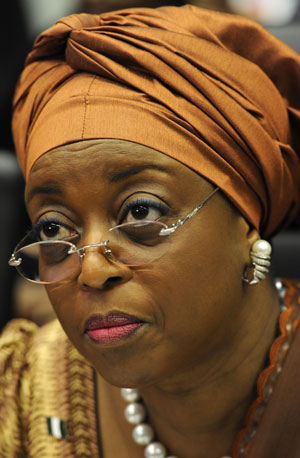
Diezani Alison-Madueke
Addressing state House correspondents after yesterday’s Federal Executive Council, the Minister said she was not leaving the country, adding that she had no reason to do so.
She blamed what she described as consistent malicious and libellous attacks on her person on the reforms she brought about in the oil and gas sector in the country.
The minister said: “Let me state it clearly for the records that Nigeria is my country and am not going anywhere. I love my country and I do think that I have done the best for my country and I would also like to point out that these malicious, malevolence, vindictive libels coming out of places like Osun Defender and other faceless online and other entities need to stop.
“For everything that has a beginning there is an end and that is not a surprise. What is the surprise is the sort of malevolence bordering on personal malicious libel to my person during this period of time.
‘’I do believe that I have done the best for Nigeria in this job and I have attained many firsts in the history of oil and gas, especially in the reforms that we have done. In this period of time, I have stepped on many big toes, particularly the feet of the cabal in the industry when we came in.
‘’I have said severally that we will open up the industry to all Nigerians and we have, but that is not to the pleasure of certain cabal.   And I have been continuously maligned because of this and we have taken millions and in fact, billions of dollars out of the hands of multinationals and their sub-contractors and put them in the hands of Nigerians through Nigerian content.
‘’Hundreds of thousands of Nigerians have come into the oil and gas industry because of our reforms.
“Quite frankly, I think as unprecedented as it is, it does not please everybody and that cannot be helped, but let us remember the unprecedented reforms that have happened in the oil industry during our time, such as major gas reforms, the Petroleum Industry Bill, which has been completely revised, reformed and put into the hands of members of the National Assembly where it has languished for two years.”
On allegation that she was seeking the intervention of prominent Nigerians, especially former Head of State, General Abdulsalami Abubakar, to protect her from being held accountable for some of her actions in office, the minister said there was no truth in the allegation.
She said: “I believe that Gen. Abdulsalami)  has already called it unnecessary mischief.”
- See more at: http://www.vanguardngr.com/2015/04/diezani-madueke/#sthash.vatlbQHQ.dpuf

Police shot kidnapper dead while picking N3m ransom

A suspected kidnapper, Niyi Omosola, has been shot dead by the police in the Epe area of Lagos. PUNCH Metro learnt that Omosola was shot dead during a rescue operation by the police to free a victim, identified simply as Kudirat. It was gathered that Omosola, while collecting the ransom, sighted the police and decided to escape on a motorcycle when the operatives fired him. It was gathered that Omosola, who hailed from Ondo State, allegedly led a gang which kidnapped the woman in the Elemoro, Ajah area...
Sixty-two-year-old Kudirat was reportedly abducted by the gang on Thursday, April 16, at about 7pm.

Our correspondent learnt that Kudirat, a businesswoman, was inspecting the construction work at a petrol station she owned in the area when the kidnappers swooped on her and took her away.

It was gathered that the gang later contacted the family and demanded a ransom of N50m. However, after negotiation, our correspondent learnt that the the gang and the family agreed to a ransom of N3m.

PUNCH Metro learnt on Wednesday that Kudirat’s brother, who had been communicating with the gang, took the ransom to an agreed hideout in the Epe area.

However, a team of operatives led by the Special Anti-Robbery Squad Commander, Abba Kyari, was said to have trailed Kudirat’s brother to the hideout.

A police source said Omosola, while collecting the ransom, initially opened fire when he sighted the police.

He added that when the kingpin saw that he was outnumbered, he tried to escape on a motorcycle, leaving the policemen with no choice than to fire him.

He said, “The kidnappers are a notorious gang. They had conducted several operations in the area. In the latest incident, they demanded N50m initially, but when the family could not produce the amount, they finally agreed to N3m. They also arranged where the place of meeting would be in the Epe area.

“The police trailed the brother, who was taking the money to Epe, where Omosola was waiting. Immediately he collected the ransom, he suspected that policemen were around and he began to shoot sporadically.

“He got on a motorcycle and was riding off when he was gunned down. He did not die immediately.”

PUNCH Metro learnt that Omosola, who was injured, led the SARS operatives to a bush between Epe and Ijebu Ode, where the woman was held.

When the police arrived at the hideout, his gang members had reportedly fled the place.

It was gathered that Kudirat was rescued alive by the police, while Omosola eventually died from the gunshot injuries.

The Police Public Relations Officer, DSP Kenneth Nwosu, said efforts were on to apprehend the remaining gang members.

He said, “When the information was received, the operatives trailed the gang to the location.

“The kidnap kingpin actually fired at SARS operatives, who were carrying out the rescue operation, and they fired back. In the process, he was fatally wounded.

“The woman has been rescued, while the corpse has been deposited at a public morgue.

“Efforts are being intensified to arrest other fleeing members of the gang.”

Tuesday, April 14, 2015

The 9 Biggest Political Casualties Of The 2015 Nigerian General Elections By Carlhz Chinedu

The April 11 Gubernatorial and State Assembly elections have come and gone, bringing to an end over 12 months of rigorous electioneering and scheming. Winners have emerged and the also-rans are counting their financial and political loses. Some losers, however, were obviously worse affected than others. Below is a compilation of the biggest casualties of the March 28 and April 11 political hurricanes.
                                             
Mua'zu Babangida Aliyu: The Niger State "Chief Servant's" woeful performance at both the March 28 and April 11 elections has called into question his supposed status as a force to be reckoned with in the Nigerian political equation. The long-serving Chairman of the Northern States Governors' Forum (NSGF) not only failed to "deliver" his state to the PDP's Goodluck Ebele Jonathan in the Presidential Polls and in his bid to ensure that his anointed candidate, Umar Nasko, succeeds him at the Minna Government House, but he also fluffed in his quest to represent the Niger East Senatorial Zone in the 8th Senate. It's really been a season of reality checks for the once-influential governor, a politician who was reportedly being groomed by some power brokers in the North to succeed Goodluck Ebele Jonathan come 2019. He was even widely quoted in the local press few weeks ago as saying that he intends to "mark time" in the Senate while he awaits the 2019 General Elections when he would take a shot at the country's top job. All that is up in the air now. As it stands, instead of waiting in the senate, he will be marking time at home while he counts his loses and plans his next political move.
Lagos PDP: These are not the best of times for the PDP nationwide, more so in Lagos state. The party's huge losses at the polls is made much worse by the fact that Lagos state is the de facto nerve center of the APC. Depending on how the APC goes about governing both the country and the state, the once-dominant PDP may be reduced to oblivion. The PDP's sudden loss of prominence will definitely instigate a flurry of realignments and defections into the new ruling party. The losses will be asphyxiating no doubt, but the PDP's continued survival and robustness in Lagos state is crucial for the democracy over there, else the "Center of Excellence" runs the risk of becoming a one-party state where no-one dares question or check the excesses of the ruling party. Four years is not eternity; 2019 is not as far as it seems. There's enough time between now and then for the party to rediscover itself and mount a greater challenge.
David Mark and Gabriel Suswam: Not even the combined might of a two-time Senate President and an incumbent governor could stop the APC from snatching a hard-fought victory in Benue state. The PDP's latest defeat in Benue didn't come as a surprise to many this time around, following its shock loss in the state at the presidential polls. The party's overall poor showing at the National Assembly elections will almost certainly cost David Mark the presidency of Nigeria's Upper Legislative Chamber — a position which he has held since 2007 — while Governor Suswam's running battle with the Benue state civil servants has cost him both a ticket to the 8th Senate and a governorship ticket for his anointed candidate, Terhemen Tarzoor. What becomes of both men in the Nigerian political arena come the next administration is anyone's guess.
Nuhu Ribadu: The revered former anti-corruption boss' sojourn into the murky waters of politics has so far not been fruitful. He contested and lost the 2011 Presidential elections on the platform of the ACN to the PDP's Goodluck Jonathan. In 2014, he controversially defected to the PDP from what had morphed into the APC with hopes of contesting on the platform of the PDP and probably winning the Adamawa state gubernatorial election. However, it was not to be. He was gifted the opportunity of running for the office, but he was always doomed to fail, following alleged anti-party activities and sabotage by members of his own party. This culminated in a comprehensive defeat on April 11, where he finished in an embarrassing third place.
Chibuike Amaechi: His party may have been victorious at the Presidential polls, but it's been a pyrrhic victory for the APC chieftain. His failure to "deliver" his state to the All Progressives' Congress a fortnight ago was partially overlooked and forgiven amidst the euphoria surrounding their triumph at the national level, but April 11's heavy defeat will not go unnoticed. The Director-General of the APC Presidential Campaign Council could do little as his party was trounced in a state where he is the governor, at the hands of the his arch rival, the Dame Patience Jonathan-backed Nyesom Wike of the PDP. Amaechi may be an integral part of the incoming APC-led federal government, but back home in the South South, his influence has been significantly whittled down.
Namadi Sambo: Even his status as the incumbent Vice President and a one-time governor of Kaduna could not ward off a heavy loss for his party in his home state. Though no-one really expected him to "deliver" the North — or even the North West  — to the PDP, the low-key and ever-smiling Vice President should have brought much more to the table in the March 28 and April 11 elections than he ended up doing.
Adamu Mu'azu: This has been the People's Democratic Party's worst performance since its inception in 1998, prior to Nigeria's return to civilian rule. Every organization has a leader whose responsibilities are to manage its affairs and accept culpability for the outcomes of his managerial decisions and tactics, especially when they are negative. In this instance, Mu'azu (branded the "Game Changer" by his PDP colleagues) must shoulder the blames for his party's disastrous outing in the just-concluded polls, though it was not entirely of his own making. Under his watch, the PDP lost several states where it was once dominant, including Plateau, Niger, Adamawa, Benue, Katsina and Kaduna (Abia will also likely be lost to APGA),  and it put up a limp performance in Opposition-controlled states where it was expected to do much better, including Oyo, Ogun, Nasarawa, Kano, Kwara, Sokoto, Lagos and Bauchi, his home state. Considering the amount of resources that was poured into the 2015 general elections by the PDP, the end product has been nothing short of disastrous.
Goodluck Ebele Jonathan: He's, without a doubt, the biggest loser here, yet the manner in which he quickly conceded defeat and saved the country another round of senseless bloodshed has made him victorious in defeat. His political miscalculations, faux pas, misguided appointments and perceived leniency towards corruption all conspired to make him the first incumbent Nigerian Head of State to lose a presidential election. That notwithstanding, His Excellency deserves our dispassionate commendation for overseeing one of the most peaceful and successful elections in Nigeria's history, even in the face of intense pressure to manipulate the process.
Carlhz Chinedu is a sociopolitical commentator and a social justice activist.

Tuesday, April 7, 2015

Femi Aribisala: How Jega defeated Jonathan for Buhari in the election

              Femi Aribisala

 If you did not see my column last week, it was because I did not want to rain on anyone’s parade. I wanted the euphoria over the bullet we missed by avoiding the riots that would have ensued had the APC been defeated to subside. But I am now back to tell you that the presidential election was a big INEC rigmarole. Long before Jonathan lost the election to Buhari, he had been defeated by the machinations of Jega and INEC.

As a matter of fact, General Buhari did not win this presidential election: President Jonathan lost it. The president lost because he allowed himself to be defeated. Maybe he did not want to remain in power badly enough. Or maybe there was a side of him that felt there is honour in being the first incumbent president to lose an election in Nigeria. Whatever the case; he failed to heed the warning of many that, like Aminu Tambuwal and Lamido Sanusi, Attahiru Jega was working for the enemy.
Failure of Tinubu
With the coalition of Bola Tinubu’s ACN and Buhari’s CPC, many concluded that the outcome of the 2015 presidential election would be determined in the South-West. The assumption was that Tinubu would provide the killer-punch that had been missing in Buhari’s earlier failed attempts. However, this has proved to be mistaken. Tinubu failed to clean up the South-West with his broom for the APC. Indeed, in order for the APC to prevail in Lagos with only 160,000 votes, INEC had to ensure that many non-indigenes could not get their PVCs.
The truth of the matter is that, quite apart from the shenanigan of having a Redeemed Yoruba pastor as Buhari’s vice-presidential running-mate, the people of the South-West don’t like Buhari. In the 2011 election, they said this emphatically by giving him a paltry 321,000 votes out of the 4.7 million cast in the geopolitical zone. This time, in 2015, Buhari received 2.4 million South-West votes, with a plurality of 600,000 over Jonathan. However, most of those votes were actually not for Buhari: they were against Jonathan.
In the end, the South-West vote was neither pivotal to Buhari’s victory nor central to Jonathan’s defeat. Tinubu’s assistance for Buhari ended at the APC presidential primaries where he got Buhari nominated against the wishes of Northern delegates. All Tinubu did at the level of the presidential election was to give a façade of national spread to Buhari’s essentially Northern victory. This factor will soon come to haunt Tinubu and his South-West cohorts when it is time to share the spoils of victory in the Buhari administration.
Should APC lose the Lagos governorship election, Tinubu would be left in a quandary. All the Northern timber and caliber who were missing in action throughout the campaign when Tinubu, Fashola and other Southern politicians were running helter-skelter with Buhari, will soon come out of the woodwork to claim their Buhari inheritance. Inevitably, they will overshadow the Southern brigade. Vice-President Osinbajo will simply be sent to fetch water when crucial decisions are to be made by Northern “born-to-rule” elements.
Southerners without coattails
In order to defeat the PDP, APC needed to undermine Jonathan in his areas of greatest strengths – the South-South and the South-East. However, APC men like Amaechi, Okorocha and Oshiomhole proved to be paper-tigers in these areas. In Rivers, Amaechi was disgraced. With all his bluster, he could only deliver 69,000 votes to Buhari; while Jonathan made off with a whopping 1.45 million. No wonder, therefore, that the governor tried to save face by saying there was no election in Rivers. He even rented a crowd to go on a perfunctory demonstration.
Chinem Bestman sent me a text message from Port Harcourt with the same complaint that the election was rigged. I answered by asking him if there has ever been a free and fair election in Rivers since 1999. Amaechi knew the ropes, therefore when he came for accreditation, he asked to see the election result sheet. He knew the traditional rigmarole in Rivers was to doctor the report sheet. Now that he has been out-rigged, he is singing a different tune; asking Rivers people to forgive him.
In Imo, Okorocha was humiliated. He could only deliver 19% of the vote to Buhari. It looks like the governor is going to need another job very soon as he is unlikely to be re-elected. In Edo, Oshiomhole did much better. APC lost with 208,000 votes to PDP’s 286,000. Nevertheless, Oshiomhole tried to explain this away by complaining that PDP used the military to manipulate the election. However, when INEC announced the results, APC won the senatorial election in Edo North; one of the places where the governor claimed PDP used the military to rig.
Assault on the South-East
Godsday Orubebe grabbed the microphone during the collation of the election results and alleged to the whole world that INEC chairman Attahiru Jega is partial and tribalistic. His outburst may have been embarrassing, but it is not entirely without justification. The evidence of INEC’s partiality is compelling. Although President Jonathan put a call to Orubebe to stop his protest, and he has decided to accept the verdict of INEC, that does not mean we should sweep INEC’s shenanigans under the carpet.
It is easy to fob off Orubebe by saying he was only being emotional because he is a PDP man from Niger Delta, a kinsman of Mr. President who “lost” the election. That just won’t cut it. I am not a Niger Deltan. I don’t belong in the PDP. I don’t know Goodluck Jonathan and I have never ever met him or spoken to him. Cynical Nigerians believe anyone who supports Jonathan must either be in his pay or be looking for a job. Neither allegation is applicable to me. Jonathan ostensibly received 12.8 million votes; surely all these people were neither in his pay nor Aso Rock job-seekers.
My faith requires me to support the weak. Therefore, I will always support the minority against the tyranny of the majority. We cannot be reliant on South-South oil in Nigeria and then treat one of their sons as if he is an impostor for being president of the country. The fact of the matter is that this presidential election was the result of a vicious and malicious gang-up of the majority ethnic groups against the minorities.
Since the civil war, the Igbos of the South-East have been treated as if they are a minority ethnic group in Nigeria when in fact they are one of the majorities. In order to diminish Jonathan’s votes, a major assault was made against them; recognising that they are some of the staunchest Jonathan supporters. In 2011, the Igbo gave Goodluck Jonathan a decisive 5 million votes. The task of INEC in 2015 was to ensure that did not recur.
INEC rigmarole
Buhari prevailed as a result of a deliberate disenfranchisement of the Igbo by INEC through the manipulation of PVC distribution and the failure of the card reader in the South-East and the South-South. INEC ensured that, far more disproportionately and relative to other geopolitical zones, millions of South-East voters disappeared between 2011 and 2015, in order to provide a smooth passage for a Northern presidential candidate; which turned out to be Buhari.
The first strategy of INEC in this regard was to create 29,000 additional polling units, allocating 21,000 of these to the North and only 8,000 to the South. In this crass manipulation, INEC gave more additional polling units to Abuja than it gave to the entire South-East. However, widespread outcry over this proposal forced INEC to jettison it despite protracted resistance by Jega.
But INEC had a plan B: the registration of voters and the collection of PVCs. This was bogus and lopsided; skewed most especially against the South-East where only 7.6 million were registered and 5.6 million PVCs collected. Compare this with the war-torn North-East: 9.1 million were registered and 7.4 million collected. But the most outrageous were the figures of the North-West. 17.6 million registrations and 15.1 million collections were recorded in the North-West; much more than the figures in the entire South-East and South-South combined.
On Election Day, news of a bomb blast in Enugu served to discourage people from coming out to vote in the South-East. In addition, there was widespread late voter accreditation and voting in the South-East as well as the South-South. One reason for this was the massive failure of the card-readers in these zones, highly suggestive that they were programmed to fail there.
Quite incredibly, the card-reader failed to recognise even the president. It took President Jonathan 35 minutes to get accredited; but within five hours, we are meant to believe that 2.5 million voters in Kano were duly accredited. In the middle of the election, INEC changed from card-reader to manual accreditation. This suddenly brought into play the huge voter registrations in the North-West. Cell-phone video recordings showed many of the North-West’s bloated PVC holders to be under-aged children.
Abracadabra
The total effect of these machinations is that over 2.4 million South-East voters were successfully disenfranchised. 38 million people nationwide voted for Buhari and Jonathan in 2011. In 2015, this figure shrank to 28 million. The votes of the South-West remained virtually constant. 4.6 million people of the South-West voted in 2011: 4.2 million in 2015. But compare this with what happened in the South-East. 5 million people voted in 2011, only 2.6 million in 2015. That is a drastic drop of 2.4 million.
While Kano, Katsina, Kaduna, Jigawa and Bauchi were posting their traditional humongous figures; Imo, Anambra and Abia were posting relatively disappointing figures. Jigawa used to be a part of Kano, when Kano was said to be bigger than Lagos. In the 2015 election, the votes of Jigawa and Kano combined was double that of Lagos. Lagos had 1.4 million votes. Jigawa and Kano had 3.1 million; virtually all for Buhari.
 While the internally displaced Northerners in the North-East could vote, internally displaced Igbos from the North could not. In places like Lagos and Kano, many non-indigenes were not even given their PVCs. In effect, the innovation of the Permanent Voters Cards is designed to permanently disenfranchise the South. If this is not redressed immediately, the North will always determine the winner in Nigerian elections.

Thursday, March 5, 2015

PVC and CARD READER: WHAT INEC AND JEGA SHOULD HAVE DONE DIFFERENTLY .. By WALE ADETARAMI @WaleAdetarami


                                                                   Prof Attahiru Jega

As a firm believer in transparent, free and fair election, I always throw my weight behind processes, developments, actions and technologies that could make it achievable. In Sub Sahara Africa, we always have this problem of election rigging; reluctance of incumbent to vacate office when defeated in an election; violence before, during and after election; voters’ intimidation; voters’ inducement and so on, we continue to make mockery of this great continent before the whole world, this is one of the reasons why many countries in Africa will never move out of the status of underdeveloped, the economy will never be the sole indicator to be used for assessment. Sadly people who perpetrate these acts are not fighting for the people but for themselves. Do we need people from the developed countries to come and oversee or conduct our elections for us? The answer is No, Nigeria is a sovereign state, we are independent, and we have attained this status for more than five decades, fifty-five years to be precise. It is about time we start getting things right, Nigeria should not be a place where we cannot conduct credible elections anymore, or a place where corruption, bad governance, nepotism, impunity, abuse of power reign supreme, not to talk of economic evils.
Now to the business of the day, the 2015 elections are fast approaching, we are aware of the plan by the independent national electoral commission (INEC) to  use permanent voters cards and card readers for the general elections, the advantage of the two is that they guarantee the authenticity of voters and reduce rigging to the minimum, while an average progressive Nigerian applauds this development, it is not going down well with perceived election riggers in Nigeria and they are using all their might to stop the use, whether they will succeed or not I don’t know. The ground these elements are using has to do with the number of people who have collected the PVC and the reliability of the card readers, since it is just being introduced into our electoral system. As at 3rd of March, 2015, INEC announced that they have achieved 80% level of distribution of the PVCs. What INEC and Professor Jega should have done differently is to use the data submitted by voters at point of registration for the distribution of the PVCs.
INEC have in their records home addresses and telephone numbers of voters, what have they done with them, If my PVC is in your possession and you have my phone number, what stops you from sending short message service (SMS) to me to tell me the exact location where my card is and the contact of the person holding it? If the SMS did not work, why not call me and tell me precisely where to go to, to pick my card? The third alternative is to use the house numbers to trace the owners of the cards, I am sure with this suggestion we would have achieved more than 80% by now. Though it is not possible to achieve 100% level of distribution, the reasons are not far-fetched, frictional factors that  cause people to move from one place to another, death of some of the voters, multiple registrations, apathy to election are factors strong enough to whittle the rate of collections. To me, I will say about 95% percent collection rate can be regarded as 100%.

Wale Adetarami lives in Lagos, Nigeria
Follow him on twitter@WaleAdetarami

Wednesday, March 4, 2015

Average penis size – Los Angeles Times

Researchers have irrevocably answered one of the most compelling questions in the field of medicine: What is a normal size for a penis?
The answer, according to anatomically precise measurements of up to 15,521 men from around the world, is 3.6 inches (9.16 centimeters) in the resting state and 5.2 inches (13.12 centimeters) when erect.
These average lengths are just two of the findings reported in BJU International, the official journal of the British Assn. of Urological Surgeons and a handful of other medical societies. But previous to we go on to more of their results, let’s pause for another question:
Why should anyone spend any amount of time trying to map this out?
The research team – from King’s College London, King’s College NHS Foundation Trust and South London and Maudsley NHS Foundation Trust – offered several reasons. A scientifically validated answer may help doctors reassure men with conditions like “small penis anxiety” or body dysmorphic disorder who endure considerable distress due to the size of their organ. It could also help manufacturers design best condoms with lower failure rates.
So the group conducted an exhaustive search for published studies with reliable assessments of penile length and girth. To qualify, studies had to include 50 or more male volunteers who were at least 17 years ancient. Would-be participants were disqualified if they suffered from erectile dysfunction or had any physical abnormalities, counting implants. Only studies with careful measurements taken by health professionals were included in the analysis.
The researchers wound up with 20 studies that evaluated thousands of men. They assumed that if they plotted all the measurements, the delivery of penis sizes would fall along a bell curve. Then they used that to come up with charts that showed length and girth by percentile.
It takes 3.6 inches from the root of the penis to the tip of the glans to hit the 50th percentile for flaccid length. That means 68% of men measure between 3 and 4.2 inches, and 95% are in the 2.4- to 4.8-inch range.
Furthermore, with an average length of 5.2 inches for an erect penis, 68% of men measure between 4.5 and 5.8 inches and 95% are in the 3.9- and 6.5-inch range.
The average circumference, or girth, of a resting penis is 3.7 inches (9.31 cm); for an erect penis, it’s 4.6 inches (11.66 cm).
Their investigation presented an chance for the researchers to test the validity of the folklore surrounding penis size. They found no convincing support in the data for the thought that penis size is correlated with the length of one’s index finger or the ratio of the length of the second and fourth fingers. Nor was there any excellent evidence that foot size was a predictor of penis size. Age, body mass index and testicular volume were also unrelated.
But, the data did show that height offered some predictive value for estimating penis length. The correlation was weak but statistically significant, according to the study.
The overwhelming majority of men included in the analysis were Caucasian or Middle Eastern, and only a few hundred were of African or Asian descent. That made it impossible “to draw any conclusions about any differences in penile size across different races,” the researchers wrote.
Despite the large number of men included in the study, the researchers said their results might be biased if well-endowed men were more inclined to be measured. They also acknowledged that the findings – though intended to provide reassurance to most people – could timely up to half of all men to feel “defective” or “abnormal” upon learning that their measurements are below average.
If so, a 2006 study from the journal Psychology of Men & Masculinity might make some of them feel best. After surveying more than 52,000 people, researchers from UCLA and CSULA found that while 45% of men wished they had a larger penis, 85% of women thought their partner’s organs were just fine.
If scientists research it, we will tell you about it! Follow me on Chirrup @LATkarenkaplan and “like” Los Angeles Times Science & Health on Facebook.
Copyright © 2015, Los Angeles Times

Thursday, February 26, 2015

Buhari’s Speech at Chatham House – Nigeria’s Transition


Now, let me quickly turn to Nigeria. As you all know, Nigeria’s fourth republic is in its 16th year and this general election will be the fifth in a row.
Permit me to start by thanking Chatham House for the invitation to talk about this important topic at this crucial time. When speaking about Nigeria overseas, I normally prefer to be my country’s public relations and marketing officer, extolling her virtues and hoping to attract investments and tourists. But as we all know, Nigeria is now battling with many challenges, and if I refer to them, I do so only to impress on our friends in the United Kingdom that we are quite aware of our shortcomings and are doing our best to address them.
The 2015 general election in Nigeria is generating a lot of interests within and outside the country. This is understandable. Nigeria, Africa’s most populous country and largest economy, is at a defining moment, a moment that has great implications beyond the democratic project and beyond the borders of my dear country.
So let me say upfront that the global interest in Nigeria’s landmark election is not misplaced at all and indeed should be commended; for this is an election that has serious import for the world. I urge the international community to continue to focus on Nigeria at this very critical moment. Given increasing global linkages, it is in our collective interests that the postponed elections should hold on the rescheduled dates; that they should be free and fair; that their outcomes should be respected by all parties; and that any form of extension, under whichever guise, is unconstitutional and will not be tolerated.
With the fall of the Berlin Wall in 1989, the dissolution of the USSR in 1991, the collapse of communism and the end of the Cold War, democracy became the dominant and most preferred system of government across the globe. That global transition has been aptly captured as the triumph of democracy and the ‘most pre-eminent political idea of our time.’ On a personal note, the phased end of the USSR was a turning point for me. It convinced me that change can be brought about without firing a single shot.
As you all know, I had been a military head of state in Nigeria for twenty months. We intervened because we were unhappy with the state of affairs in our country. We wanted to arrest the drift. Driven by patriotism, influenced by the prevalence and popularity of such drastic measures all over Africa and elsewhere, we fought our way to power. But the global triumph of democracy has shown that another and a preferable path to change is possible. It is an important lesson I have carried with me since, and a lesson that is not lost on the African continent.
In the last two decades, democracy has grown strong roots in Africa. Elections, once so rare, are now so commonplace. As at the time I was a military head of state between 1983 and 1985, only four African countries held regular multi-party elections. But the number of electoral democracies in Africa, according to Freedom House, jumped to 10 in 1992/1993 then to 18 in 1994/1995 and to 24 in 2005/2006. According to the New York Times, 42 of the 48 countries in Sub-Saharan Africa conducted multi-party elections between 1990 and 2002.
The newspaper also reported that between 2000 and 2002, ruling parties in four African countries (Senegal, Mauritius, Ghana and Mali) peacefully handed over power to victorious opposition parties. In addition, the proportion of African countries categorized as not free by Freedom House declined from 59% in 1983 to 35% in 2003. Without doubt, Africa has been part of the current global wave of democratisation.
But the growth of democracy on the continent has been uneven. According to Freedom House, the number of electoral democracies in Africa slipped from 24 in 2007/2008 to 19 in 2011/2012; while the percentage of countries categorised as ‘not free’ assuming for the sake of argument that we accept their definition of “free” increased from 35% in 2003 to 41% in 2013. Also, there have been some reversals at different times in Burkina Faso, Central African Republic, Cote D’Ivoire, Guinea, Guinea-Bissau, Lesotho, Mali, Madagascar, Mauritania and Togo. We can choose to look at the glass of democracy in Africa as either half full or half empty.
While you can’t have representative democracy without elections, it is equally important to look at the quality of the elections and to remember that mere elections do not democracy make. It is globally agreed that democracy is not an event, but a journey. And that the destination of that journey is democratic consolidation – that state where democracy has become so rooted and so routine and widely accepted by all actors.
With this important destination in mind, it is clear that though many African countries now hold regular elections, very few of them have consolidated the practice of democracy. It is important to also state at this point that just as with elections, a consolidated democracy cannot be an end by itself. I will argue that it is not enough to hold a series of elections or even to peacefully alternate power among parties.
It is much more important that the promise of democracy goes beyond just allowing people to freely choose their leaders. It is much more important that democracy should deliver on the promise of choice, of freedoms, of security of lives and property, of transparency and accountability, of rule of law, of good governance and of shared prosperity. It is very important that the promise embedded in the concept of democracy, the promise of a better life for the generality of the people, is not delivered in the breach.
Now, let me quickly turn to Nigeria. As you all know, Nigeria’s fourth republic is in its 16th year and this general election will be the fifth in a row. This is a major sign of progress for us, given that our first republic lasted five years and three months, the second republic ended after four years and two months and the third republic was a still-birth. However, longevity is not the only reason why everyone is so interested in this election.
The major difference this time around is that for the very first time since transition to civil rule in 1999, the ruling Peoples Democratic Party (PDP) is facing its stiffest opposition so far from our party the All Progressives Congress (APC). We once had about 50 political parties, but with no real competition. Now Nigeria is transitioning from a dominant party system to a competitive electoral polity, which is a major marker on the road to democratic consolidation. As you know, peaceful alternation of power through competitive elections have happened in Ghana, Senegal, Malawi and Mauritius in recent times. The prospects of democratic consolidation in Africa will be further brightened when that eventually happens in Nigeria.
But there are other reasons why Nigerians and the whole world are intensely focussed on this year’s elections, chief of which is that the elections are holding in the shadow of huge security, economic and social uncertainties in Africa’s most populous country and largest economy. On insecurity, there is a genuine cause for worry, both within and outside Nigeria. Apart from the civil war era, at no other time in our history has Nigeria been this insecure.
Boko Haram has sadly put Nigeria on the terrorism map, killing more than 13,000 of our nationals, displacing millions internally and externally, and at a time holding on to portions of our territory the size of Belgium. What has been consistently lacking is the required leadership in our battle against insurgency. I, as a retired general and a former head of state, have always known about our soldiers: they are capable, well trained, patriotic, brave and always ready to do their duty in the service of our country.
You all can bear witness to the gallant role of our military in Burma, the Democratic Republic of Congo, Sierra Leone, Liberia, Darfur and in many other peacekeeping operations in several parts of the world. But in the matter of this insurgency, our soldiers have neither received the necessary support nor the required incentives to tackle this problem. The government has also failed in any effort towards a multi-dimensional response to this problem leading to a situation in which we have now become dependent on our neighbours to come to our rescue.
Let me assure you that if I am elected president, the world will have no cause to worry about Nigeria as it has had to recently; that Nigeria will return to its stabilising role in West Africa; and that no inch of Nigerian territory will ever be lost to the enemy because we will pay special attention to the welfare of our soldiers in and out of service, we will give them adequate and modern arms and ammunitions to work with, we will improve intelligence gathering and border controls to choke Boko Haram’s financial and equipment channels, we will be tough on terrorism and tough on its root causes by initiating a comprehensive economic development plan promoting infrastructural development, job creation, agriculture and industry in the affected areas. We will always act on time and not allow problems to irresponsibly fester, and I, Muhammadu Buhari, will always lead from the front and return Nigeria to its leadership role in regional and international efforts to combat terrorism.
On the economy, the fall in prices of oil has brought our economic and social stress into full relief. After the rebasing exercise in April 2014, Nigeria overtook South Africa as Africa’s largest economy. Our GDP is now valued at $510 billion and our economy rated 26th in the world. Also on the bright side, inflation has been kept at single digit for a while and our economy has grown at an average of 7% for about a decade.
But it is more of paper growth, a growth that, on account of mismanagement, profligacy and corruption, has not translated to human development or shared prosperity. A development economist once said three questions should be asked about a country’s development: one, what is happening to poverty? Two, what is happening to unemployment? And three, what is happening to inequality?
The answers to these questions in Nigeria show that the current administration has created two economies in one country, a sorry tale of two nations: one economy for a few who have so much in their tiny island of prosperity; and the other economy for the many who have so little in their vast ocean of misery.
Even by official figures, 33.1% of Nigerians live in extreme poverty. That’s at almost 60 million, almost the population of the United Kingdom. There is also the unemployment crisis simmering beneath the surface, ready to explode at the slightest stress, with officially 23.9% of our adult population and almost 60% of our youth unemployed. We also have one of the highest rates of inequalities in the world.
With all these, it is not surprising that our performance on most governance and development indicators (like Mo Ibrahim Index on African Governance and UNDP’s Human Development Index.) are unflattering. With fall in the prices of oil, which accounts for more than 70% of government revenues, and lack of savings from more than a decade of oil boom, the poor will be disproportionately impacted.
In the face of dwindling revenues, a good place to start the repositioning of Nigeria’s economy is to swiftly tackle two ills that have ballooned under the present administration: waste and corruption. And in doing this, I will, if elected, lead the way, with the force of personal example.
On corruption, there will be no confusion as to where I stand. Corruption will have no place and the corrupt will not be appointed into my administration. First and foremost, we will plug the holes in the budgetary process. Revenue producing entities such as NNPC and Customs and Excise will have one set of books only. Their revenues will be publicly disclosed and regularly audited. The institutions of state dedicated to fighting corruption will be given independence and prosecutorial authority without political interference.
But I must emphasise that any war waged on corruption should not be misconstrued as settling old scores or a witch-hunt. I’m running for President to lead Nigeria to prosperity and not adversity.
In reforming the economy, we will use savings that arise from blocking these leakages and the proceeds recovered from corruption to fund our party’s social investments programmes in education, health, and safety nets such as free school meals for children, emergency public works for unemployed youth and pensions for the elderly.
As a progressive party, we must reform our political economy to unleash the pent-up ingenuity and productivity of the Nigerian people thus freeing them from the curse of poverty. We will run a private sector-led economy but maintain an active role for government through strong regulatory oversight and deliberate interventions and incentives to diversify the base of our economy, strengthen productive sectors, improve the productive capacities of our people and create jobs for our teeming youths.
In short, we will run a functional economy driven by a worldview that sees growth not as an end by itself, but as a tool to create a society that works for all, rich and poor alike. On March 28, Nigeria has a decision to make. To vote for the continuity of failure or to elect progressive change. I believe the people will choose wisely.
In sum, I think that given its strategic importance, Nigeria can trigger a wave of democratic consolidation in Africa. But as a starting point we need to get this critical election right by ensuring that they go ahead, and depriving those who want to scuttle it the benefit of derailing our fledgling democracy. That way, we will all see democracy and democratic consolidation as tools for solving pressing problems in a sustainable way, not as ends in themselves.
Prospects for Democratic Consolidation in Africa: Nigeria’s Transition
Permit me to close this discussion on a personal note. I have heard and read references to me as a former dictator in many respected British newspapers including the well regarded Economist. Let me say without sounding defensive that dictatorship goes with military rule, though some might be less dictatorial than others. I take responsibility for whatever happened under my watch.
I cannot change the past. But I can change the present and the future. So before you is a former military ruler and a converted democrat who is ready to operate under democratic norms and is subjecting himself to the rigours of democratic elections for the fourth time.
You may ask: why is he doing this? This is a question I ask myself all the time too. And here is my humble answer: because the work of making Nigeria great is not yet done, because I still believe that change is possible, this time through the ballot, and most importantly, because I still have the capacity and the passion to dream and work for a Nigeria that will be respected again in the comity of nations and that all Nigerians will be proud of.
I thank you for listening.